


Fibromuscular Dysplasia vs. Atherosclerosis: What’s the Difference?



Have you been told:
- Your arteries are narrowed, but no one can quite explain why?
- You have high blood pressure that won’t respond to the usual medications, even though you’re young and otherwise healthy?
These can be signs of two very different vascular conditions, and knowing which one you’re dealing with changes everything about your treatment plan.
It’s important to be aware that there are differences between Fibromuscular dysplasia vs. atherosclerosis, because while both narrow the arteries, they don’t share a cause, patient profile, or a treatment plan.
Quick Answer: Fibromuscular dysplasia (FMD) and atherosclerosis both narrow the arteries, but the resemblance mostly ends there. FMD is a non-atherosclerotic (a condition that doesn’t involve plaque in the arteries), non-inflammatory disease caused by abnormal cell growth in the artery wall, typically affecting younger to middle-aged women in the renal and carotid arteries.¹² Atherosclerosis is fatty plaque buildup tied to smoking, cholesterol, and aging, and it tends to show up in older adults, more often men, near the origin of the artery rather than further down it.¹ Because both can cause hypertension, headaches, and stroke risk, the only way to tell them apart reliably is imaging.
Fibromuscular Dysplasia vs. Atherosclerosis: What’s actually happening in the artery

FMD is a non-atherosclerotic, non-inflammatory disease that causes abnormal cell growth within the artery wall, producing sections that alternately narrow and widen, a “string of beads” appearance on imaging. It most often affects the renal arteries, carotid and vertebral arteries, and less commonly the coronary arteries, typically in the middle and distal portions of the vessel rather than near its origin.¹³
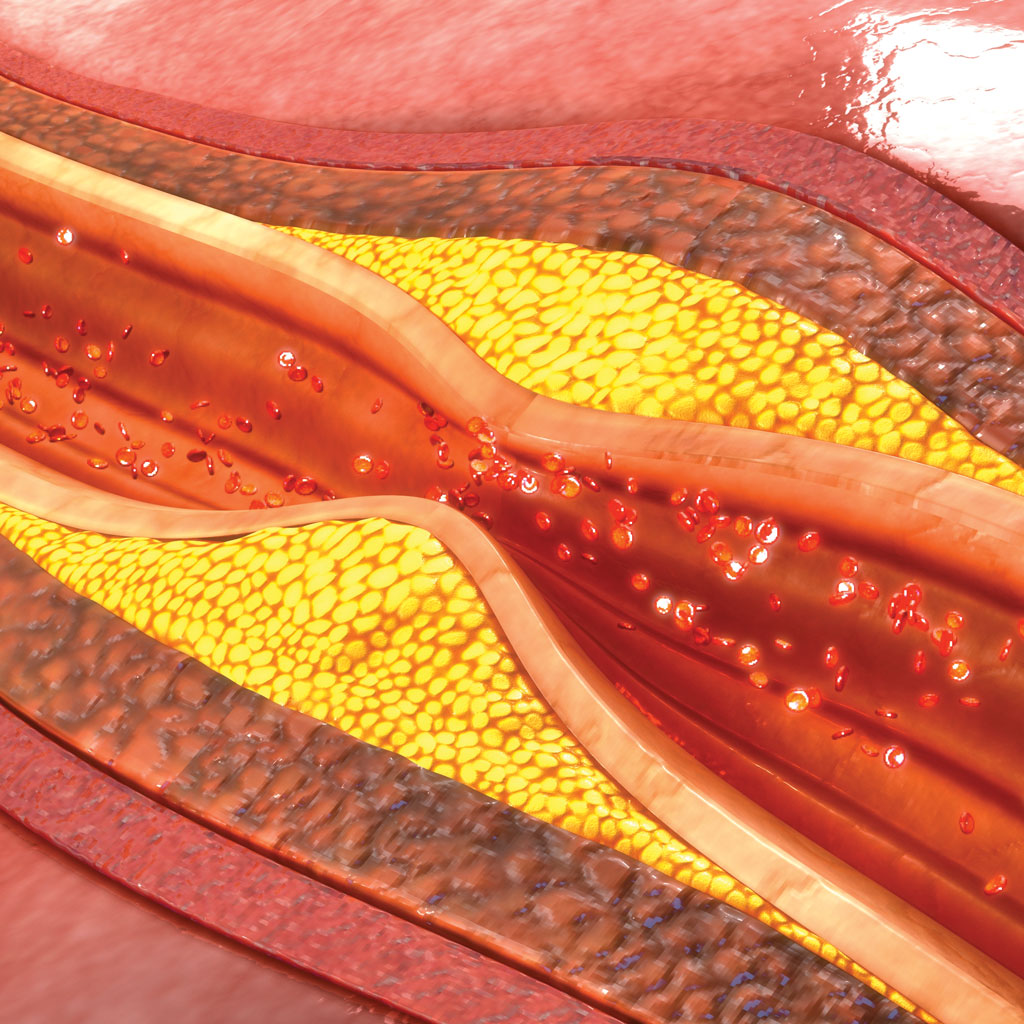
Atherosclerosis, by contrast, is the gradual buildup of fatty deposits, cholesterol, and other substances (plaque) along the inner artery wall. It tends to develop at the proximal segments, closer to where an artery branches off from a larger vessel, and progresses over years or decades as it narrows the passage and restricts blood flow.¹ Unlike FMD, it’s strongly tied to manageable risk factors like blood pressure and cholesterol, which is part of why prevention and lifestyle change play such a large role in managing it.
Fibromuscular Dysplasia vs. Atherosclerosis symptoms
So how do you know which one your symptoms point toward? Many people with either condition have no symptoms at all and are only diagnosed when imaging for something unrelated happens to catch it.
Fibromuscular dysplasia symptoms tend to include high blood pressure that’s difficult to control (especially in younger patients), headaches or migraines, pulsatile tinnitus (a rhythmic thumping or whooshing in the ear), dizziness, neck pain, or stroke-like symptoms if the carotid or vertebral arteries are involved.² FMD disproportionately affects women, often between their 30s and 50s, and is frequently mistaken for stress, anxiety, or migraines rather than investigated as a vascular issue.
Atherosclerosis symptoms more often develop silently for years before appearing, and typically include leg pain or cramping while walking that eases with rest, chest pain or pressure, shortness of breath, numbness or coldness in the limbs, or confusion and sudden weakness if the carotid arteries are involved.
If you notice several of these signs together, especially treatment-resistant high blood pressure at a young age or leg pain with walking, talk to a vascular specialist rather than waiting to see if it improves on its own.
What causes each condition?
Atherosclerosis is driven largely by accumulated risk: smoking, high blood pressure, high cholesterol, diabetes, obesity, and a sedentary lifestyle. These factors build up over time, which is why atherosclerosis is more common in older adults.
FMD doesn’t follow the same pattern. Its exact cause isn’t fully understood, but genetic and hormonal factors are suspected to play a role, and some cases run in families.² It isn’t preventable in the way atherosclerosis often is, but it can be effectively managed once identified.
When to see a vascular specialist
Because FMD and atherosclerosis can produce overlapping symptoms, both cause narrowed arteries, high blood pressure, and stroke risk, a vascular specialist relies on targeted imaging, such as duplex ultrasound, CT angiography, or catheter-based angiography, to pinpoint which condition is actually responsible.¹ It’s also possible to have both at once, particularly in older patients, which is another reason imaging matters more than guessing based on age or symptoms alone.¹
Seek prompt medical attention for sudden neurological symptoms such as facial drooping, arm weakness, or difficulty speaking, as well as treatment-resistant high blood pressure that develops at an unusually young age.
Can FMD be mistaken for atherosclerosis?
Yes. Both conditions can narrow arteries, but they have different causes and often produce different patterns on vascular imaging.
Can you have FMD and atherosclerosis at the same time?
Yes. Having FMD does not prevent someone from developing atherosclerosis, particularly as cardiovascular risk factors accumulate with age.
Does FMD cause plaque buildup?
No. FMD is classified as a nonatherosclerotic arterial disease, meaning the narrowing isn’t caused by cholesterol-containing plaque.
What does FMD look like on imaging?
The most common form, multifocal FMD, can produce alternating areas of narrowing and widening that create the characteristic “string-of-beads” appearance.
Comprehensive vascular care at North Star
North Star Vascular & Interventional evaluates and treats both conditions for patients across the Minneapolis–St. Paul area, including fibromuscular dysplasia, peripheral artery disease, carotid artery disease, and renal artery stenosis with related hypertension.
If your blood pressure, headaches, or circulation symptoms don’t have a clear explanation yet, schedule a vascular evaluation with North Star Vascular & Interventional at northstarir.com/contact.
Sources
- Jebari-Benslaiman S, et al. Differential Diagnosis: Fibromuscular Dysplasia vs. Atherosclerosis. Klarity Health Library. Published February 1, 2025. https://my.klarity.health/differential-diagnosis-fibromuscular-dysplasia-vs-atherosclerosis/
- Racial Differences in Fibromuscular Dysplasia. medRxiv preprint. 2023. https://www.medrxiv.org/content/10.1101/2023.02.10.23285630
- Comparing coronary artery fibromuscular dysplasia with coronary atherosclerosis: from clinical to histopathological characteristics. ScienceDirect. 2018. https://www.sciencedirect.com/science/article/abs/pii/S1054880717303563
- van Twist DJL, Houben AJHM, de Leeuw PW, Kroon AA. Lateralization of renal blood flow and renin secretion in fibromuscular dysplasia. Journal of Hypertension. 2017;35(8):1720-1721. https://pubmed.ncbi.nlm.nih.gov/28060190/




Contact us today to schedule an appointment or to speak with one of our knowledgeable staff members.



Suite 340
Golden Valley, MN 55427